
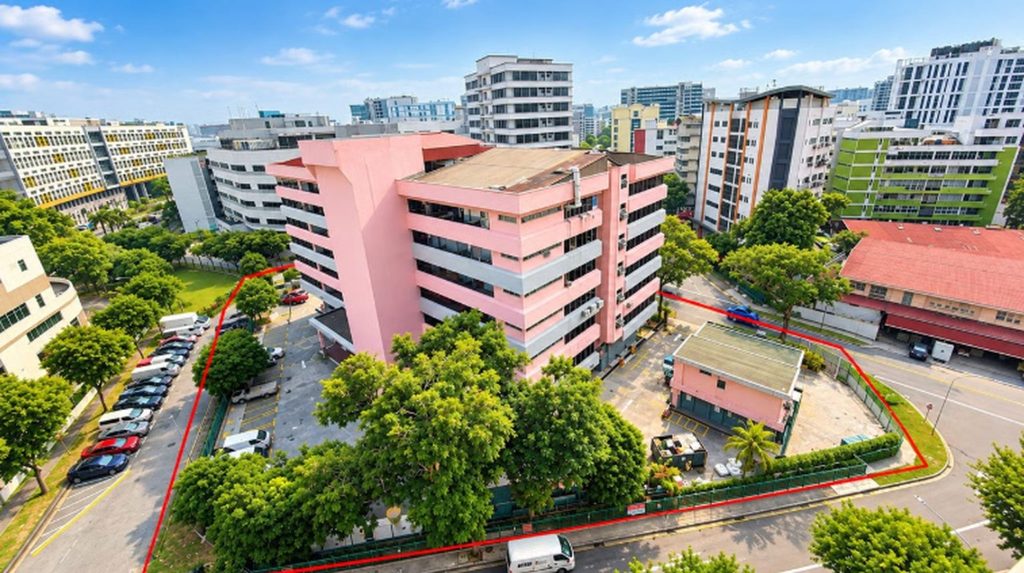
Jun Jie Industrial Building at 153 Kampong Ampat was sold en bloc for $121.8 million to LWH Holdings following a public tender exercise where more than a dozen interested parties submitted bids (clear indication that investor interest in freehold industrial properties located strategically remains strong).
The sale price was about 16% above the initial guide price of $105m so it was a big collective sale in Singapore industrial property market for 2026.
Jun Jie Industrial Building is located in the established Tai Seng and MacPherson industrial precinct and has a prominent freehold corner site with redevelopment potential. Its location, land tenure, existing floor area of industrial use and Business 1 zoning were some of the factors that attracted developers, investors and owner occupiers to view the site.
Jun Jie Industrial Building Sold for $121.8 Million. Jun Jie Industrial Building (153 Kampong Ampat Singapore 368326) was sold collectively for S$121.8m to Singapore construction and property developer LWH Holdings.
The property was put on collective sale in late September 2026 with an indicative guide price of $105 million. The public tender closed on 23 October 2026 and more than a dozen bids were received from different groups of prospective purchasers.
The final sale price was approximately 16% above the guide price which shows how competitive the interest in this freehold industrial development was.
With gross floor area of approximately 114,969 sq ft the sale price is around $1,059 per sq ft which is another important reference point for investors when comparing freehold industrial property values in Tai Seng and MacPherson area.
Knight Frank Singapore was appointed the sole marketing agent for the collective sale. LWH Holdings was announced as the successful buyer.
Jun Jie Industrial Building – Property Overview
Jun Jie Industrial Building is a seven-storey multi user industrial development at the junction of Kampong Ampat and Upper Aljunied Link. The property is on freehold land of approx 43,354 sq ft (gross floor area) with existing gross floor area of approx 114,969 sq ft. The corner location gives good road frontage and visibility in the established industrial neighbourhood.
The site is zoned Business 1 (B1) under URA Master Plan 2025 with gross plot ratio of 2.5 which allows clean and light industrial activities subject to planning guidelines and approved uses.
Here are the key property details:
| Property details | Information |
|---|---|
| Development | Jun Jie Industrial Building |
| Address | 153 Kampong Ampat, Singapore 368326 |
| Property type | Multi-user industrial |
| Tenure | Freehold |
| Building height | 7 storeys |
| Land area | Approx. 43,354 sq ft |
| Existing GFA | Approx. 114,969 sq ft |
| Zoning | Business 1 |
| Plot ratio | 2.5 |
| Guide price | $105 million |
| Transacted price | $121.8 million |
| Transacted rate | Approx. $1,059 psf on existing GFA |
| Buyer | LWH Holdings |
| Marketing agent | Knight Frank Singapore |
About LWH Holdings
LWH Holdings is a Singapore based construction and property development group with business interests in construction, civil engineering, piling works and real estate development. The group operates through its core brand Lim Wen Heng Construction and has been involved in various construction projects in Singapore.
It is involved in developments at Bukit Sembawang Estates (LIV at Mountbatten and phases of Luxus Hills) so it is part of Singapore’s construction and development industry.
The Jun Jie Industrial Building ($121.8 million) was the group’s largest industrial property purchase yet but its plans for the site have not been announced publicly.
Strategic Location in Tai Seng and MacPherson Industrial Estate.
Location is key when buying industrial property so Jun Jie Industrial Building is located within the established Tai Seng and MacPherson industrial precinct.
Surrounding neighbourhood includes industrial buildings, commercial developments, warehouses and business facilities. This is an established environment for companies involved in manufacturing engineering distribution technology other supporting industrial activities.
The property is also accessible from Pan Island Expressway (PIE) and Kallang-Paya Lebar Expressway (KPE) which connect Singapore to other parts of the island.
For public transport Tai Seng MRT Station on the Circle Line serves the surrounding industrial neighbourhood so there is another commuting option for employees and business visitors.
Its proximity to established business clusters also means the area is relevant to companies looking for industrial premises with supporting businesses and a wider workforce.
Freehold industrial property has strong buyer interest.
One of the key factors behind Jun Jie Industrial Building sale was its freehold tenure. Freehold industrial properties are few and far between in Singapore as many industrial developments are on leasehold land with varying remaining lease periods. For investors and developers freehold ownership provides a different long-term property ownership proposition than industrial assets that are subject to lease expiry.
More than a dozen bids were received in the tender from different buyers types – industrial developers looking for strata redevelopment opportunities; owner-occupiers wanting a large freehold industrial property and investors assessing workers’ dormitory use possibilities.
The strong participation illustrates the different ways buyers might evaluate an existing industrial building based on their investment objectives and intended property use.
The final sale price of $121.8 million ($16m above the guide price) also demonstrates how competitive this freehold industrial site was.
Potential for industrial redevelopment.
In addition to being an existing industrial building, Jun Jie Industrial Building has substantial freehold land area and a good location so redevelopment possibilities exist.
43,354 sq ft of land (gross plot ratio 2.5) and planning intensity (developers may wish to consider when assessing future development opportunities).
On the basis of plot ratio given above, gross floor area under planning parameters would be ~108,385 sq ft (subject to URA requirements and confirmation of final development parameters).
In the future, redevelopment could be modern multi-user industrial development for businesses that need industrial space with supporting facilities and convenient access.
Strata industrial developments may also be attractive to business owners who want to own their premises rather than rely entirely on leasing arrangements.
However, any redevelopment proposal would still be subject to planning permission, building regulations and the requirements of the relevant authorities.
Workers’ Dormitory Potential at Jun Jie Industrial Building.
Another interesting aspect of the collective sale was that it may have been used for secondary workers’ dormitory use.
The URA had already indicated that it was willing to support secondary workers’ dormitory use at the site on a case-by-case basis subject to planning submissions and approvals from relevant authorities, said Knight Frank Singapore. This possibility was then pursued by investors who were looking at alternative uses for the property.
Singapore’s industrial sector employs a large workforce in manufacturing, construction, logistics and other related industries. Worker accommodation can therefore be part of the wider industrial property ecosystem too. Nevertheless, it is important to distinguish between possible planning support and an approved development proposal. Workers’ dormitory use has not been confirmed as LWH Holdings’ intended use for the site.
Any future proposal would have to satisfy planning and regulatory requirements before implementation.
What does the $121.8 million sale mean for Singapore industrial property?
The successful collective sale of Jun Jie Industrial Building is another interesting reference point for Singapore’s industrial property market (freehold Business 1 properties in established industrial clusters). The deal also follows other industrial property deals in Singapore and shows interest in industrial assets with good land tenure, location and redevelopment possibilities.
For existing industrial property owners transactions of this kind are useful market references when valuing their properties – freehold tenure, land size/plot ratio, existing gross floor area, location and redevelopment potential all influence how prospective buyers view an industrial asset.
For developers the transaction also shows that suitable industrial sites need to be found which can potentially be repositioned to meet changing needs of businesses.
But the $121.8 million sale should be viewed as a particular property (not an industrial building) rather than as a direct valuation benchmark for every industrial building in Singapore.

