
Type of Lorry with Dimension
| Type | Length | Width | Height | Capacity |
|---|---|---|---|---|
| 10 Feet Lorry | 3.1m | 1.65m | 2.1m | 1.5 ton |
| 18 Feet Lorry | 5.486m | 2.2m | 3.1m | 4 ton |
| 24 Feet Lorry | 6.9m | 2.4m | 3.8m | 9 ton |
| 20 Feet Container Truck | 5.88m | 2.35m | 2.385m | 9 ton |
| 40 Feet Container Truck | 12.1m | 2.4m | 2.7m | 24 ton |
10 Feet Lorry
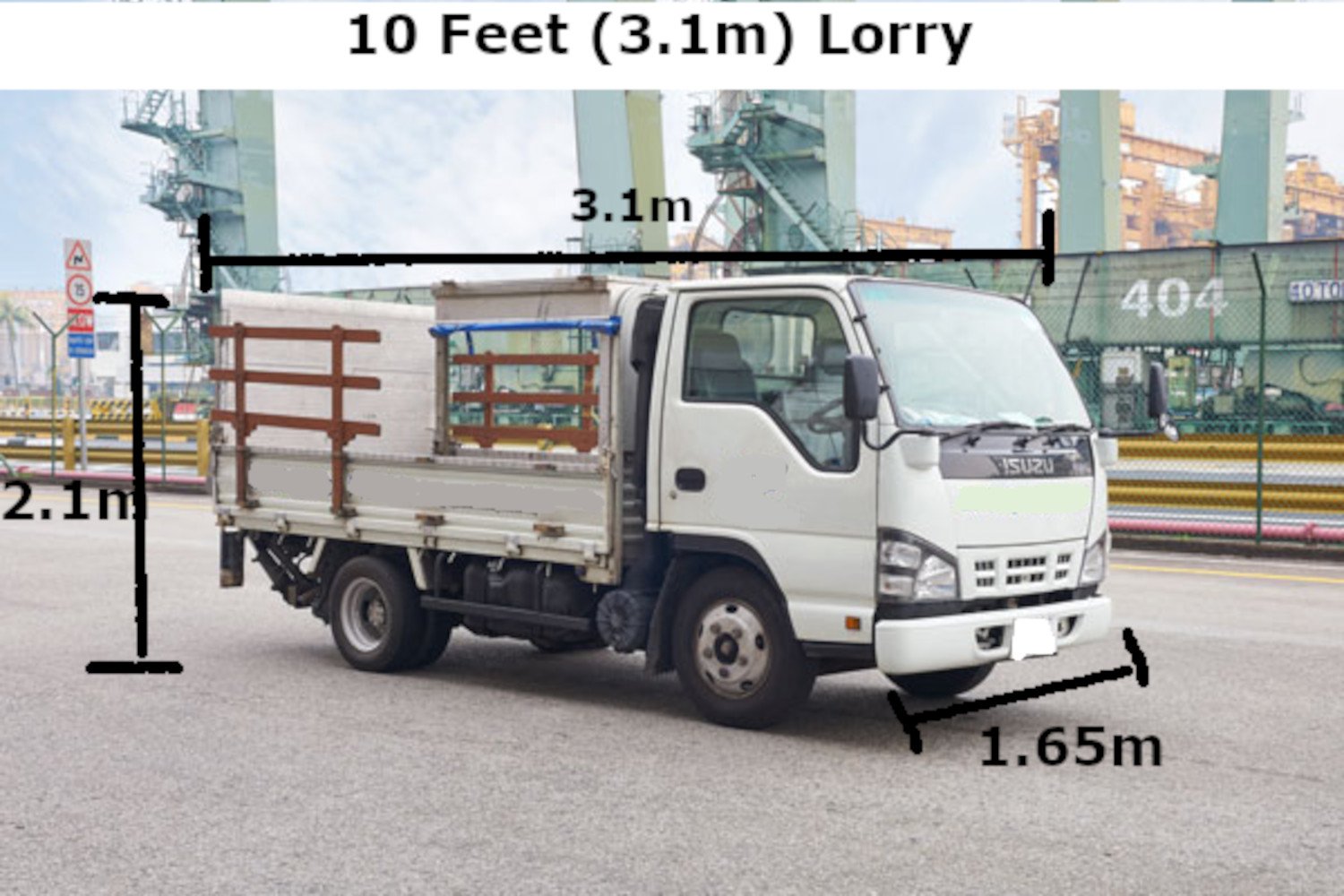
- Length: 3.1m (10 Feet)
- Width 1.65m
- Height: 2.1m
- Capacity: 1.5 ton
18 Feet Lorry
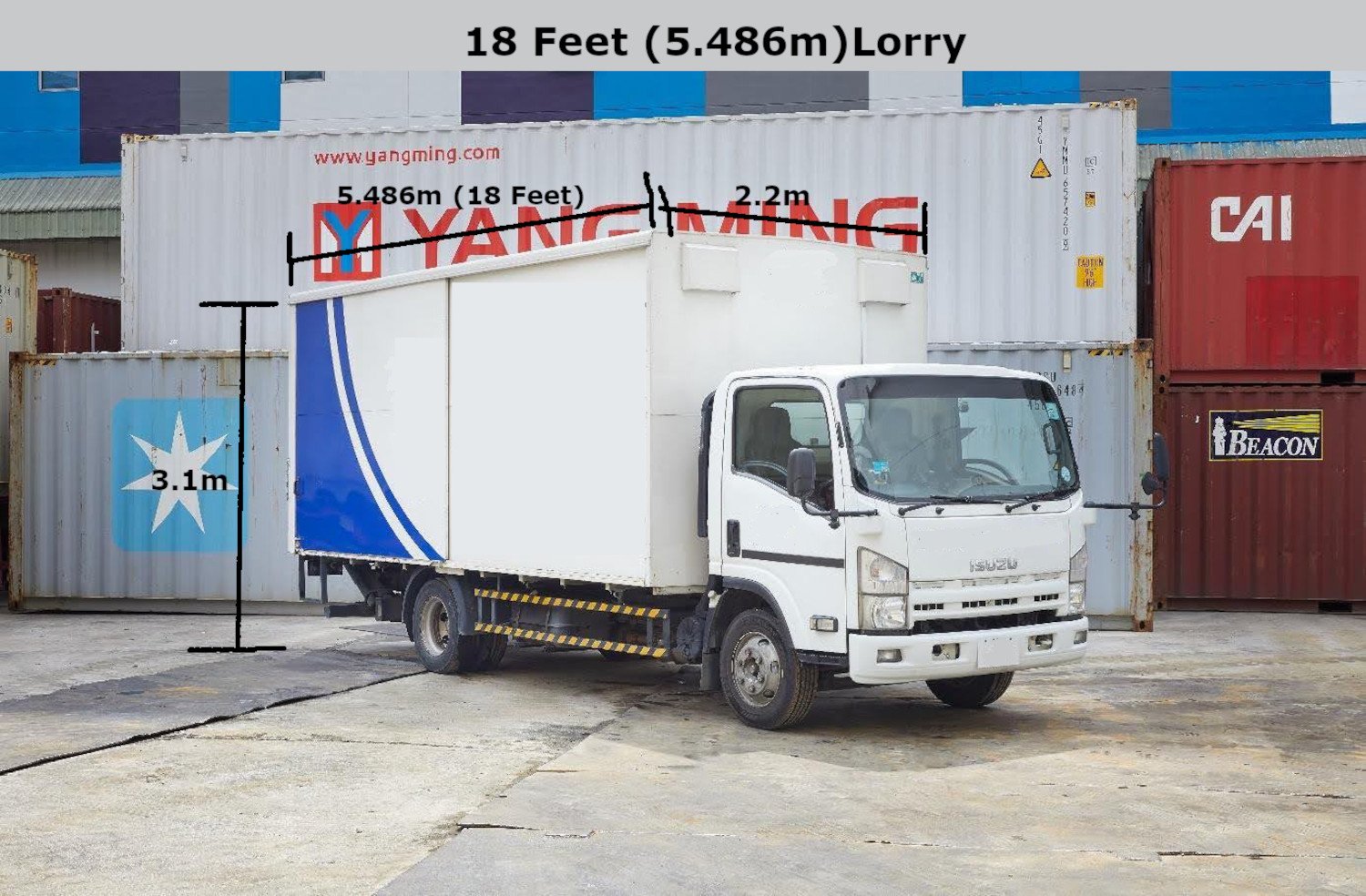
- Length: 5.486m (18 Feet)
- Width: 2.2m
- Height: 3.1m
- Capacity: 4 ton
24 Feet Lorry
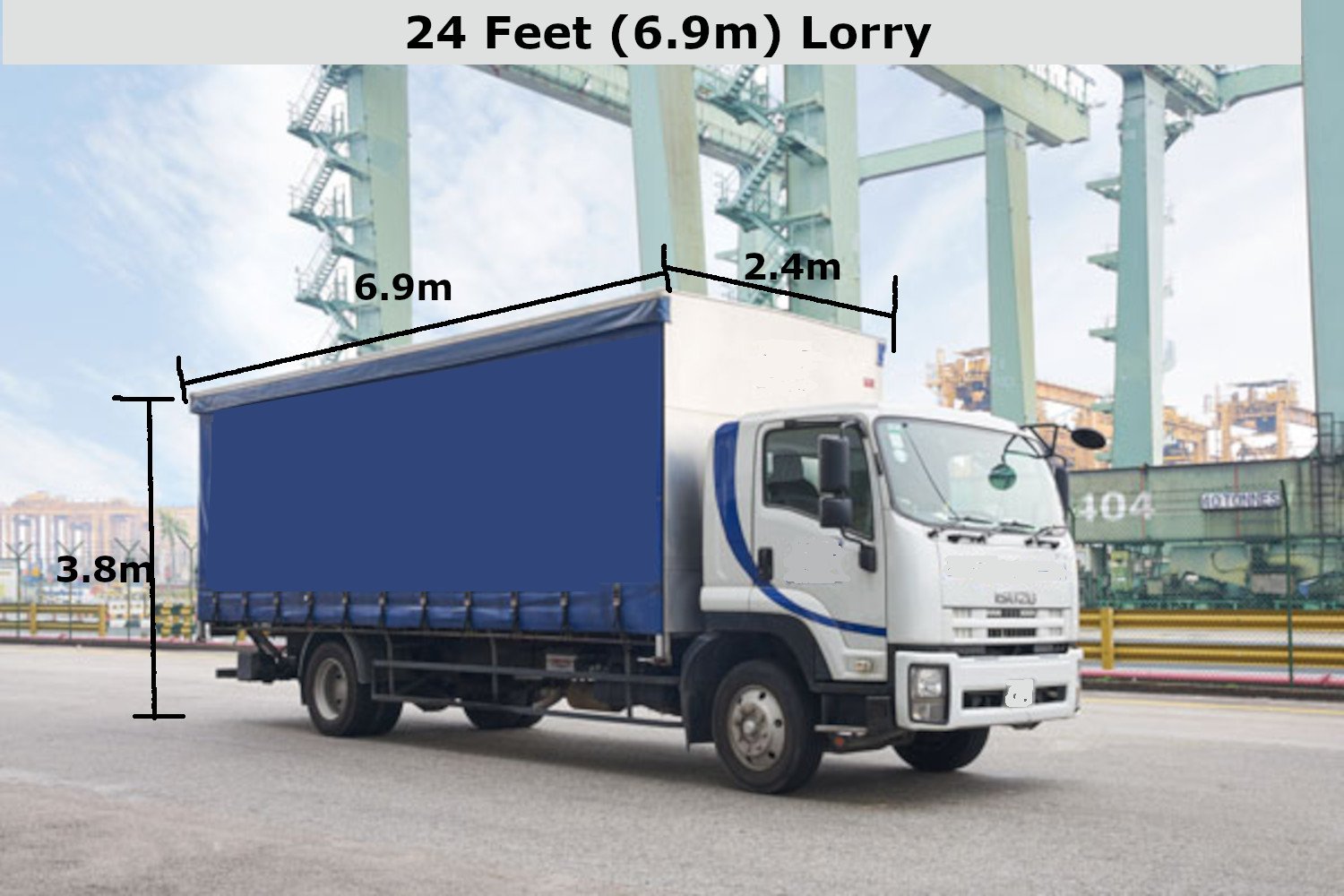
- Length: 6,9m (24 Feet)
- Width: 2.4m
- Height: 3.8m
- Capacity: 9 ton
40 Feet Container Truck
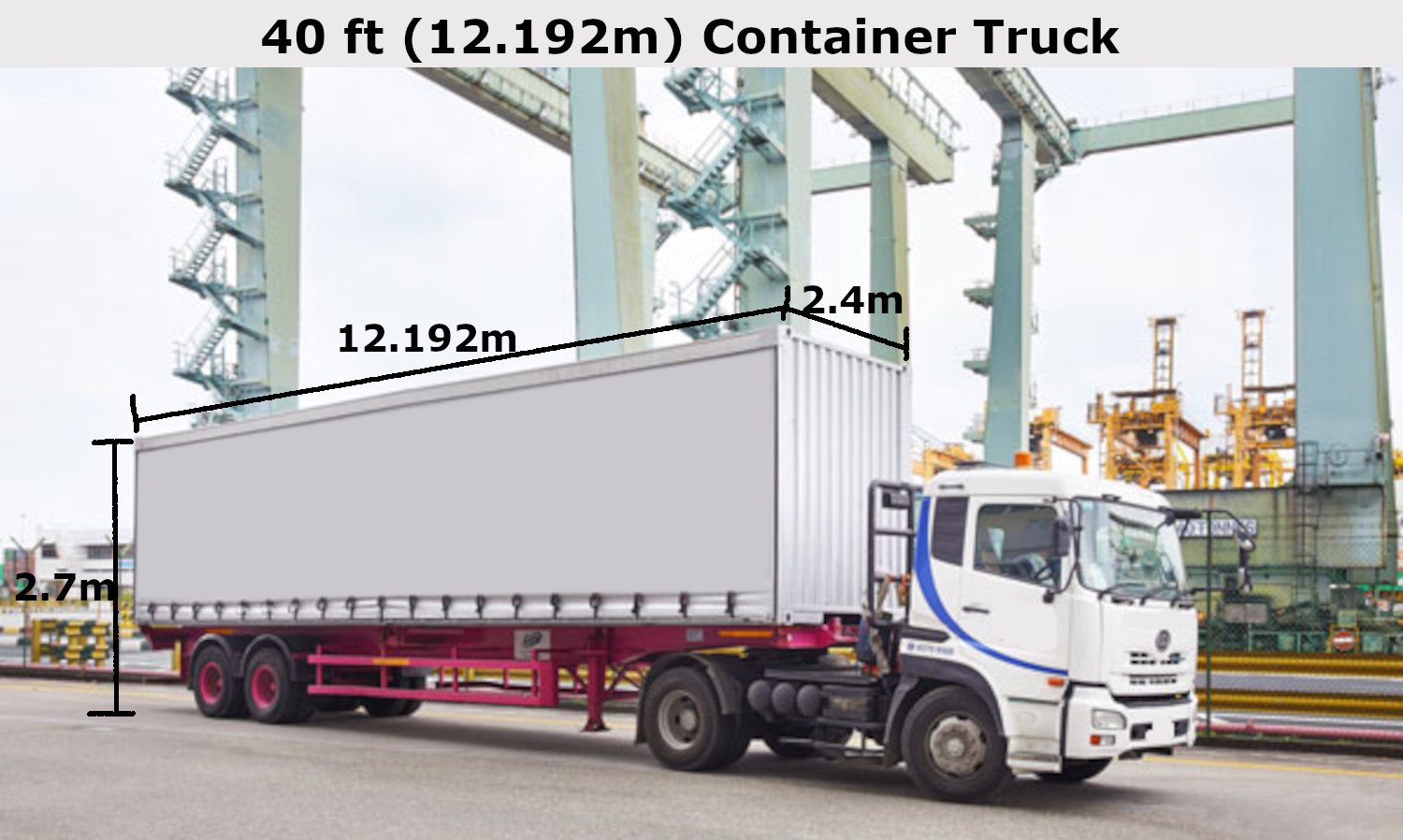
- Length: 12.192m (40 Feet)
- Width: 2.4m
- Height: 2.7m
- Capacity: 24 ton
Overview of Singapore Commercial Vehicles
Singapore’s compact road network and stringent vehicle regulations make selecting the precise lorry or truck a challenge not only for payload capacity. In the day-to-day running of the business, dimensions, height clearances, turning radius and legal classification of the vehicles matter a lot. In Singapore, goods vehicles are generally classified into Light Goods Vehicles (LGV), Heavy Goods Vehicles (HGV) and Very Heavy Goods Vehicles (VHGV) as well as several specialist vehicle types. Knowing how one category applies is useful for business owners, logistics people and drivers to not face any operational and regulatory concerns.
Light Goods Vehicles (LGV)
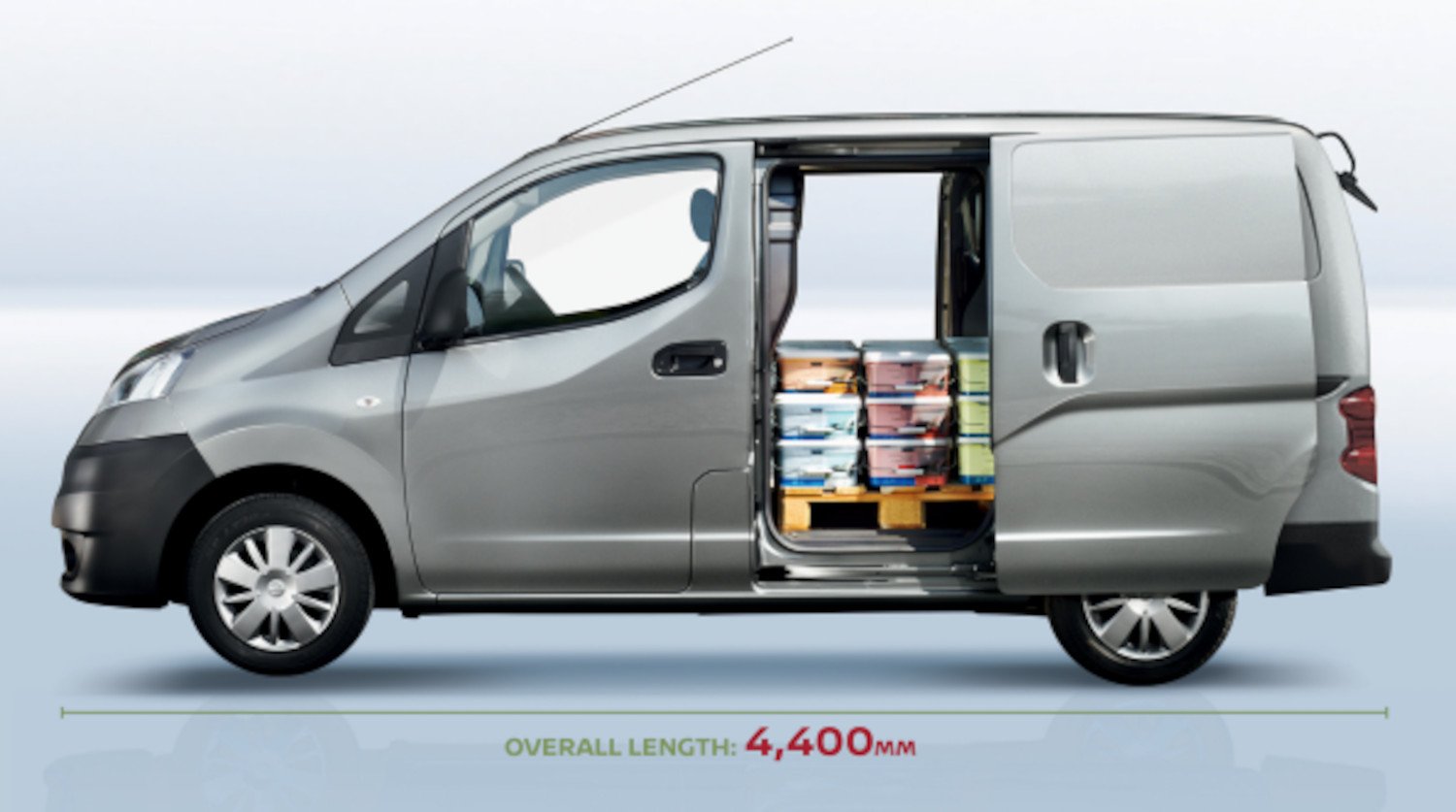
LGVs are usually used when in urban, for logistics and for short haul transport. These include cargo vans, small pickup trucks and box lorries. Even in everyday use, they are often referred to as 10-foot or 14-foot lorries, respectively, for the length of the cargo box, not the entire transport length. To describe a 10-foot box lorry, it should take about 3.0 to 3.2 metres for a cargo box to be packed. The vehicle width as a whole varies between 1.7 and 2.0 metres, while the height changes from low-roof to high-roof configuration, usually from 1.8 to 3.0 metres. They make great city delivery vehicles as they are not restricted to land and go through any single industrial estates, commercial loading bays or even several carparks with restrictions relating to height.
A 14-foot or 3-tonne lorry allows it to occupy a significantly larger volume of cargo with a box length of around 4.2 to 4.3 metres. The overall width is usually about 2.0 to 2.2 metres and frequently extends towards 3.0 to 3.2 metres. This class combines transport space and manoeuvrability, proving popular with transporting businesses, food delivery services and contractors requiring transport for bulky objects to ensure that they don’t get into heavier vehicle restrictions.
Medium Goods Vehicles
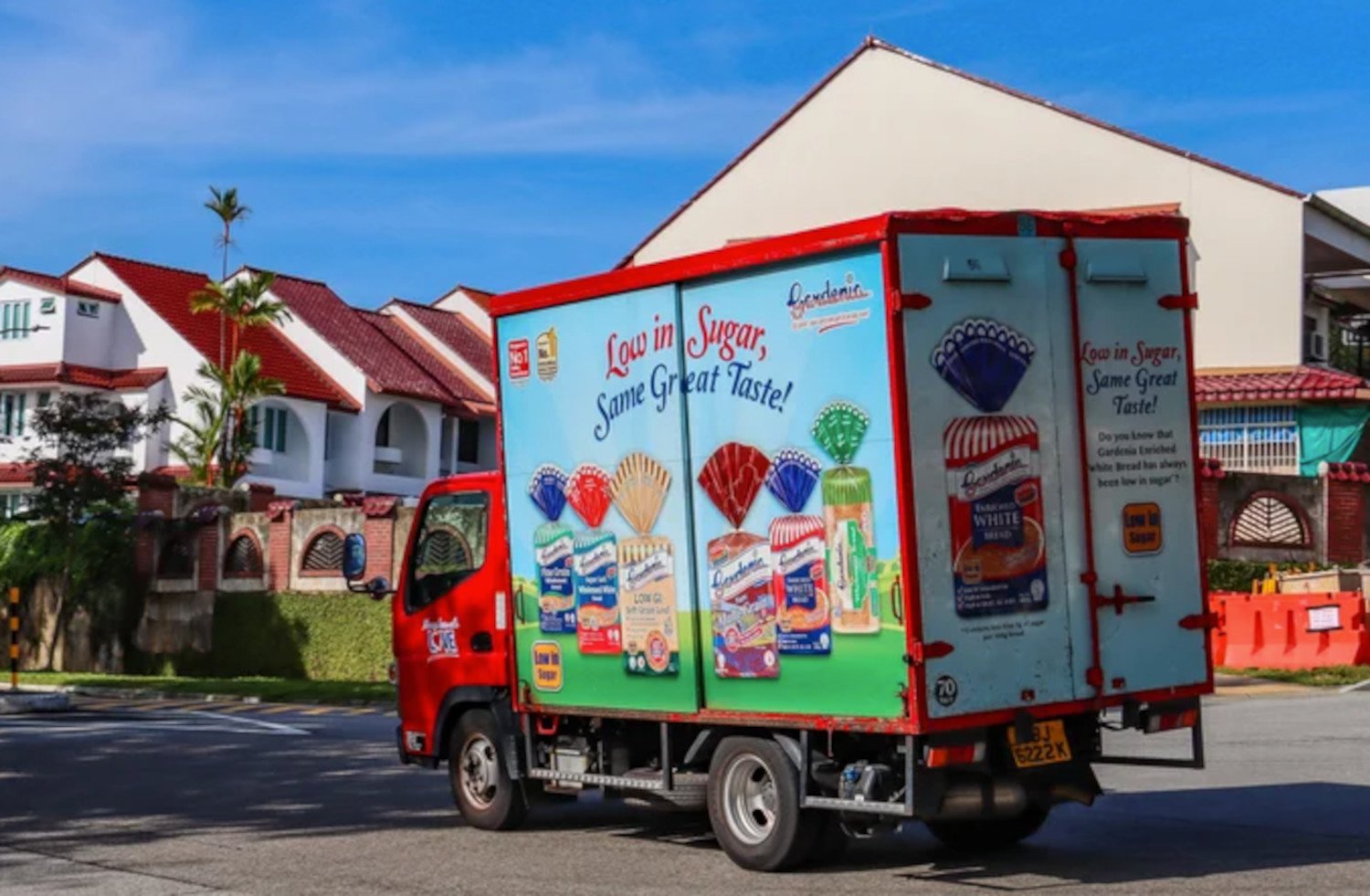
Medium goods vehicles typically include lorries with payloads ranging from 3 tonnes to approximately 10 tonnes. They are commonly called 17-foot or 20-foot lorries in industry language. For wholesale distribution, warehouse transfers and industrial deliveries, they are widely used. Typically a 17-foot box truck tends to have a cargo body length of around 5.2 metres approximately. Generally the total width will fall in the range of 2.2 to 2.4 metres, and the height, around 3.2 to 3.5 metres. Due to their larger dimension, these cars can be subject to restrictions in specific older-buildings in industrial buildings or in locations lacking good turning space.
Larger, rigid trucks that run between 20 and 24 feet can reach lengths of 7.0 metres or longer, and widths of up to 2.6 metres. There is usually height of 3.5 to 4.0 metres with regard to kind of body. These vehicles work well for high load and the transport are highly efficient but careful route planning is needed to avoid low bridges, tunnels, slender access roads.
Heavy and Very Heavy Goods Vehicles (HGV and VHGV)
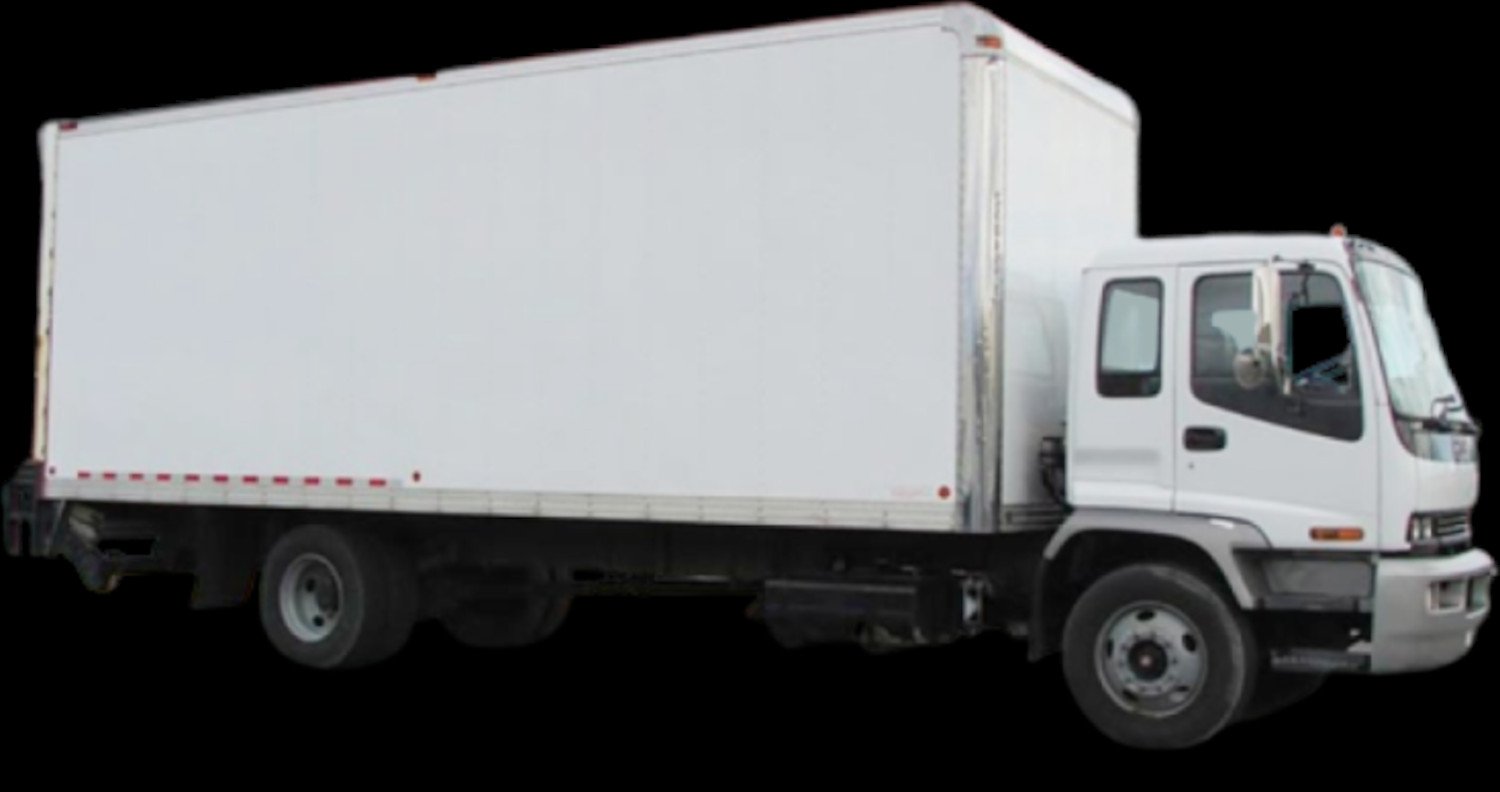
Heavy and VHGV Vehicles – multi-axle rigid trucks, prime movers and articulated vehicles used within construction, container transport and large scale logistics are included in the class. They are much bigger and heavier than regular delivery lorries. A rigid 10-tonne or multi-axle truck can exceed 8 metres overall in length and close to its maximum legal limit of 2.6 metres as well. Depending on the route, height ranges from about 4.0 metres; it meets road clearance thresholds within 4.0 metres max. These are vehicles that are often used for shipping construction materials, machinery and large palletised loads.
Trailer-mounted prime movers are commonly used for container transport. Depending on the trailer configuration, the total vehicle length can be as much as 10 to 12 metres for a typical 20-foot container. When it has a 40-foot-long container, the amount expands even further. Vehicle height has typically been set at under about 4.2 to 4.5 metres as anything that’s any taller generally needs special sign-off or escorted movement.
Trailers For Container Freight.
Trailers are used extensively in port and industrial logistics particularly for container-port transported cargo. Container sizes are standard globally, but the overall dimensions of the vehicle would vary depending on the tractor unit and trailer chassis. A low bed trailer, often used for heavy machinery, may be longer than a traditional container trailer and lower in deck height. It lowers overall vehicle height but increases length, turning radius while the cost of maintaining such a high-traffic structure can be considerable. Such vehicles – often due to their weight and size – often need to use a route licence and work through their routing with the authorities.
Rigid road freight trucks in tow trailers serve other industrial applications as well. They have freedom but are regulated to a certain extent on length, axle load and road traffic.
Specialist Lorry Types.
Other than box trucks, there are also a plethora of specialist lorries on Singapore’s roads. Common construction and earthworks: Tipper lorries and dump trucks. Its size resembles other rigid trucks of the same tonnage, but its hydraulic tipping mechanism does increase the centre of gravity during unloading, requiring proper clearance and stable ground. Refrigerated lorries are also known as reefers and are popular in the food and pharmaceutical sector for their ability to maintain a low temperature, while keeping temperatures inside the vessel. These vehicles have the same box lorry dimensions, except for the insulated walls and refrigeration units, which will result in slightly greater height and less usable internal volume.
Flatbed lorries and curtain-sided trucks are built for mass loading large or ill-suited cargo. They have outside size similar to box lorries of a similar length and provide an easier way for forklifts and cranes to reach. Lorry-mounted cranes are added on to conventional truck body for lifting, they must however meet some minimum safety and balance and stability standards.
Regulatory Limitations and Practical Considerations.
Singapore has clear regulations regarding the width, length and height of the vehicle, which are strictly enforced for safety purposes. Typical items are only allowed a width of about 2.6 metres. Height limits, in particular, are critical, since vehicles greater than about 4.5 metres typically must have special licenses or police escorts. Axle load and gross vehicle weight limits also establish approval to complete an apportionment and parking certificates.
Actually, operators will think about what the vehicle is really going to measure outside, not just in cargo. Larger loading bay heights, greater access to the basement, bridge clearance and turning space at delivery points are all critical considerations. However, technically legal a vehicle is if you don’t know the key points and then its infeasible.

